

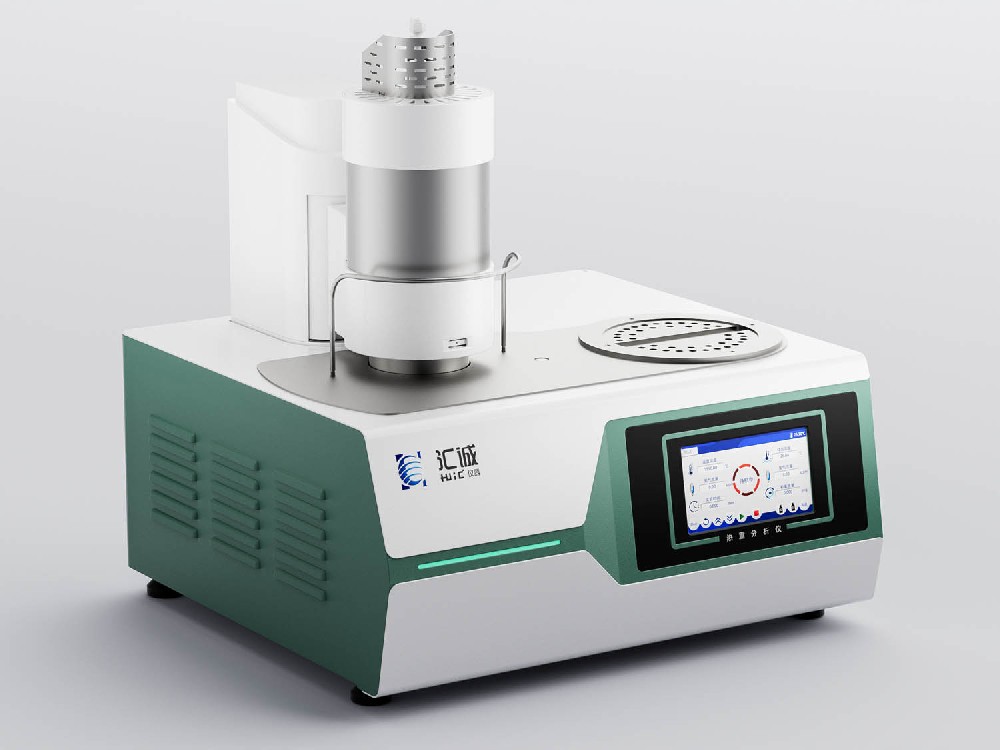
TGA‑605C Automatic Lifting Thermogravimetric Analyzer
Product Category:Thermogravimetric Analyzer
TGA-601RLift-type Thermogravimetric AnalyzerProduct IntroductionInstrument OverviewThermal gravimetric analysis (TG/TGA) involves monitoring the mass variation of a sample as a function of temperature or time during heat···
Order Hotline:025-52702696
ChatTGA-605C
Lift-type Thermogravimetric Analyzer
Product Introduction
Instrument Overview
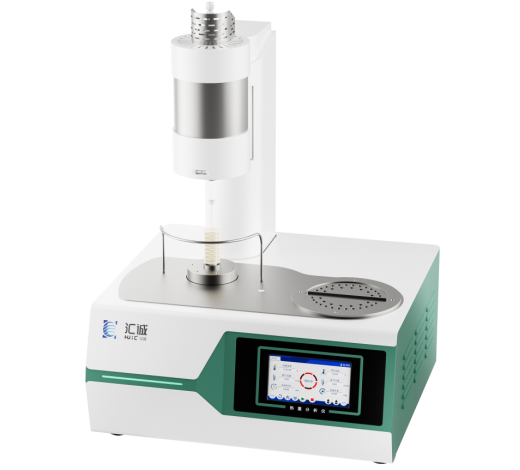
Thermal gravimetric analysis (TG/TGA) involves monitoring the mass variation of a sample as a function of temperature or time during heating, constant-temperature, or cooling processes; its purpose is to investigate the thermal stability and composition of materials. This technique is widely employed in research and development, process optimization, and quality control across various fields—including plastics, rubber, coatings, pharmaceuticals, catalysts, inorganic materials, metallic materials, and composite materials.
Instrument Purpose
Measure and investigate the following properties of the materials: thermal stability, decomposition behavior, adsorption and desorption, oxidation and reduction, quantitative composition analysis, influence of additives and fillers, moisture and volatiles, reaction kinetics, etc.
main features
1. Equipped with a built-in imported mass weighing balance featuring integrated internal calibration and temperature compensation functions, enabling rapid response to mass changes and delivering enhanced accuracy and repeatability;
2. The instrument features a built-in quality level guidance function; within the weighing pan's range, changes in the sample's position do not affect the quality measurement results;
3. The internal balance chamber is equipped with a standalone MFC module, which provides the balance with a stable inert gas protection environment; the flow rate can be automatically configured and adjusted via software;
4. The balance chamber is also equipped with a constant-temperature water bath system, which ensures a stable ambient temperature within the chamber and significantly enhances weighing stability;
5. The instrument can be used for experiments involving sample weight gain or weight loss, such as the adsorption or decomposition processes of samples;
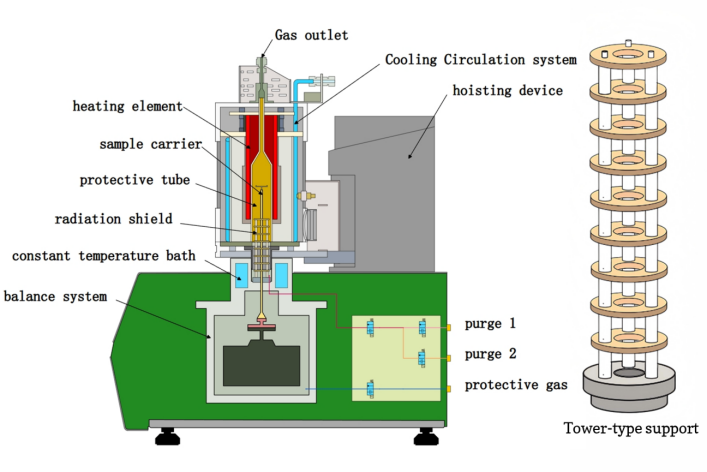
6. The furnace features a dual-axis lifting and lowering structural design, incorporating an electric vertical lifting function as well as a horizontal rotational capability. This allows the furnace to be fully relocated away from the exact overhead position of the sample holder and the balance sensor, creating a fully open, panoramic operating space;
7. The furnace body features an independent spatial positioning adjustment function, which effectively ensures that the sample holder is always maintained at an ideal thermal symmetry and flow field symmetry position within the thermal field. This design eliminates, at the mechanical level, risks such as signal drift, poor repeatability, or sample rod contact with the chamber wall resulting from installation tilt or misalignment;
8. The furnace heating elements are fabricated from silicon carbide (SiC) material, designed to meet the requirements for oxidation and corrosion resistance, high energy efficiency, and long service life; the maximum operating temperature can reach 1600°C;
9. The interior of the furnace and the balance chamber feature a sealed structural design that allows for vacuuming, thereby better ensuring the airtightness of the experimental process;
10. The furnace body is internally equipped with a capillary water circulation cooling system; this device encloses the furnace body for its cooling.
11. The furnace body can be equipped with a customizable experimental exhaust gas treatment interface according to customer requirements, enabling secondary analysis of experimental exhaust gases using techniques such as infrared spectroscopy, mass spectrometry, or gas chromatography;
12. Equipped with an innovative 360° omnidirectional rotation sensor mount, this system enables continuous, stepless rotational positioning within the horizontal plane and allows for reliable locking and securing at any angle. Operators can load samples from the most comfortable and convenient position based on the laboratory bench layout and personal preferences, which significantly enhances operational efficiency, reduces operational complexity and potential risks, and facilitates cleaning and maintenance.
13. The sensor bracket is constructed from imported materials, offering enhanced corrosion and oxidation resistance, as well as high sensor sensitivity;
14. Equipped with an independent multi-level thermal radiation shielding module to maximize the suppression of thermal radiation and convective heat transfer, thereby ensuring signal stability; this fundamentally and effectively resolves baseline drift and signal noise issues caused by thermal disturbances;
15. The sensor signal sampling frequency can be set between 0.05 Hz and 10 Hz, offering greater flexibility in experimental methodology and enhanced data control;
16. Dual temperature sensor design concept enables simultaneous measurement of both the internal furnace temperature and the sample temperature;
17. The full-temperature control system employs an optimized dynamic PID algorithm, which effectively mitigates the limitations of traditional PID algorithms and enhances the robustness of the dual-mode temperature control system;
18. The device supports two experimental modes – FTC and STC – which offer more user-friendly and flexible temperature control, enabling it to meet the diverse experimental requirements across various application scenarios. It provides more precise temperature control during the experimental process and more efficient analysis of sensor signals, ensuring accurate control over experimental outcomes;
19. An optional standalone AI interaction module is available; this module recommends expert-level experimental protocols based on user requirements, making the experimentation process more efficient and reliable, thereby significantly enhancing overall experimental efficiency.
20. A 12-stage programmable temperature control system enables greater diversity in experimental methods; the device also features a cyclic scanning function with a maximum scanning count configurable up to 9,999 cycles, and automatic data saving is supported;
21. Both the lower-level and upper-level computers of the equipment system feature a multi-point temperature calibration function, catering to the requirements of various experimental scenarios and thereby enhancing the accuracy of temperature measurements;
22. The device is equipped with an imported high-frequency core control processor, offering faster computational processing speeds and more efficient control;
23. Equipped with a multi-channel high-precision MFC mass flow meter control module, enabling more precise gas flow control and independently managed atmosphere control; intelligent software configuration allows the instrument to automatically switch between different gas flow systems, thereby enhancing experimental efficiency;
24. The equipment system can be used to conduct experiments on materials related to heating, cooling, and other isothermal processes;
25. Equipped with a 7-inch, 24-bit full-color LCD touchscreen that displays the instrument's status and data in real time;
The instrument utilizes USB bidirectional communication and features an intelligent software design with a baseline subtraction function, automatic generation of experimental reports, automated plotting of experimental data, and intelligent processing of various parameters—including glass transition temperature, oxidation induction time, melting point of substances, and crystallization behavior—among others.
technical parameter
AI Interaction Feature (Optional Module) | ||
1. Users can enter the experimental purpose according to their specific needs. 2. Supports text input, offering more flexible interaction options. 3. Recommended expert-level experimental protocols with reliable parameters 4. The software automatically imports parameters – no manual configuration required. 5. Supports multiple recommendation analysis to enhance experimental efficiency. | ||
Furnace parameters: | ||
1 | Furnace Type | carborundum(SiC) |
2 | temperature range | RT~1600℃ |
3 | temperature resolution | 0.01℃ |
4 | temperature fluctuation | ±0.01℃ |
5 | heating rate | 0.1~100℃/min |
6 | Furnace mobility | Dual-dimensional automatic lifting and lowering |
7 | Furnace chamber positioning | Equipped with a spatial positioning adjustment device |
8 | cooling-down method | Metal capillary tube circulating water cooling |
9 | cooling-off period | 40min(1000℃…100℃) |
10 | tightness | Can be evacuated |
11 | Thermal protection configuration | The furnace is equipped with a thermal shock-resistant annular tower-mounted support bracket. |
12 | Custom Configuration | Equipped with integrated TGA-FTIR, TGA-MS, and TGA-GC capabilities. |
Tianping Parameters: | ||
13 | Balance measurement range | 0.001mg-5g |
14 | Quality Resolution | 0.1μg |
15 | Balancing Room Atmosphere | Independent MFC automatic control with inert atmosphere protection |
16 | Balance room temperature | The fully automatic circulating constant-temperature water bath ensures a stable temperature field. |
Main unit specifications: | ||
17 | Constant temperature time | 0–24 h (customizable) |
18 | toggle rate | 16.6Hz |
19 | sampling rate | Programmable range: 0.05–10 Hz |
20 | Sensor Dimension | Can be rotated and adjusted freely in 360°. |
21 | Experimental Mode | FTC and STC modes – customizable settings |
22 | Experiment Type | Weightlessness, weight gain (adsorption) |
23 | MFCgroup count | Group 2 |
24 | MFCscope | 0–200 mL/min – Software-adjustable |
25 | Programmable Temperature Control | Full-range 12-stage temperature control with flexible settings |
26 | Temperature control method | Heating, Constant Temperature, Cooling |
27 | Scan count | The number of cyclic scans can be set up to a maximum of 9,999 times, with automatic data saving. |
28 | Instrument calibration | Both the lower-level and upper-level computers support a multi-point temperature calibration function. |
29 | display mode | 24-bit color 7-inch LCD touchscreen display |
30 | Ambience Control | Three audio channels can be freely configured; the instrument switches between them automatically. |
31 | Parameter Standards | Equipped with reference materials, allowing users to calibrate the temperature independently. |
32 | source | AC220V/50Hz (Customizable AC110V) |
-
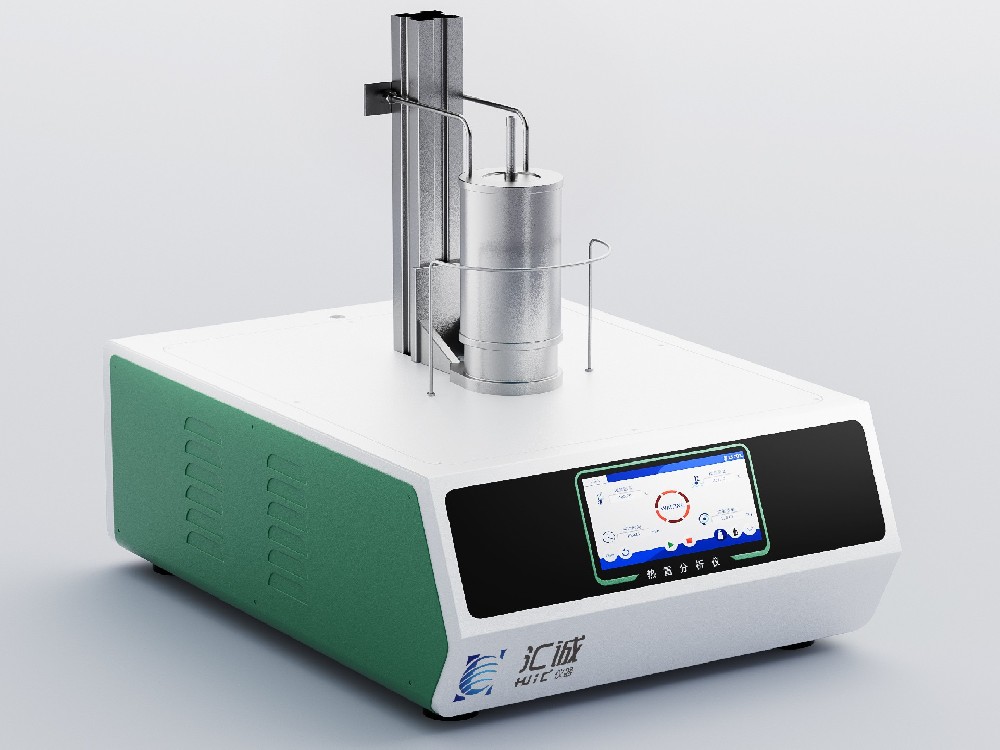 TGA -605S Thermogravimetric Analyzer
Introduction to the instrumentThermogravimetric analysis (TG, TGA) is to observe···
TGA -605S Thermogravimetric Analyzer
Introduction to the instrumentThermogravimetric analysis (TG, TGA) is to observe··· - TGA -601S Thermogravimetric Analyzer
Introduction to the instrumentThermogravimetric analysis (TG, TGA) is to observe···
- TGA‑601R Automatic Lifting Thermogravimetric Analyzer
TGA-601RLift-type Thermogravimetric AnalyzerProduct IntroductionInstrument Overv···
- Nanjing Huicheng Instrument Co., Ltd
- hotline:025-52702696
- service:025-52702696
- email:njhcyq@163.com
- Company Address:Building 47, No. 1001 Fuying Road, Jiangning District, Nanjing City, China